
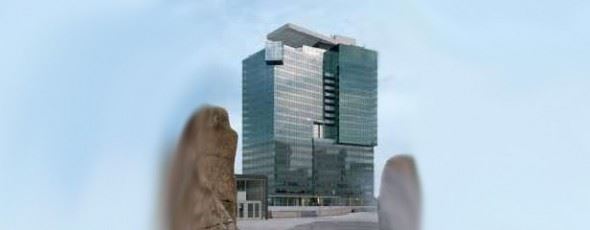
Solar control glass Sunstop T
The new SILVERSTAR SUNSTOP T range of products has four different types of shading glass that are creating
new degrees of planning freedom for summer heat insulation. The T stands for temperable. That means that these types of glass are printed and tempered as required. A maximum of high-energy properties from a second THERMOFLOAT heat-insulating layer creates greater comfort in the inside of the room.
The main focus of applications is large-surface glass facades and exterior shading glass with double-skin facades and transparent glass roofs. This is where it is especially advisable to use tempered glass. Tempering only changes the colour of SILVERSTAR SUNSTOP T slightly, meaning you can use them as floating, ESG and TVG glass in the same facade.
SILVERSTAR SUNSTOP T Neutral 50 is highly colour-neutral and has low outward light reflection, making it just right for heat-insulating glass and uncoated floating glass.
SILVERSTAR SUNSTOP T Blue 50 is bluish and very colour-neutral.
SILVERSTAR SUNSTOP T Blue 30 has slightly bluish light reflection to set
the pace in brilliant and elegant colours.
SILVERSTAR SUNSTOP T Silver 20 is the most highly expressive of our
range of products with its exciting brilliant colour reflection.
All four layer designs will dazzle you with their extremely neutral undertone.
| Type of glass with Thermofloat |
Structure [mm] |
Position of coating * |
Light characteristics [%] |
Energy characteristics [%] |
Heat transfer coefficient Ug [W/m2K] |
|||||
|
|
LT | LR | ET | EA | ER | g | air | argon | ||
| Sunstop T Neutral 50 |
6-16-4 | 2 + 3 | 45 | 14 | 31 | 54 | 15 | 38 | 1,4 | 1,1 |
| Sunstop T Blue 50 |
6-16-4 | 2 + 3 | 43 | 21 | 29 | 52 | 19 | 36 | 1,4 | 1,1 |
| Sunstop T Blue 30 |
6-16-4 | 2 + 3 | 27 | 29 | 18 | 58 | 24 | 23 | 1,4 | 1,1 |
| Sunstop T Silver 20 |
6-16-4 | 2 + 3 | 18 | 28 | 12 | 64 | 24 | 17 | 1,4 | 1,1 |
This data is based on EN 410, EN 673 requirements.
* It is required to assemble Sunstop glass with a layer of metal oxides toward the inside of a glass unit (position #2), otherwise (position #1) it causes degradation of the layer under weather conditions and air pollution.


